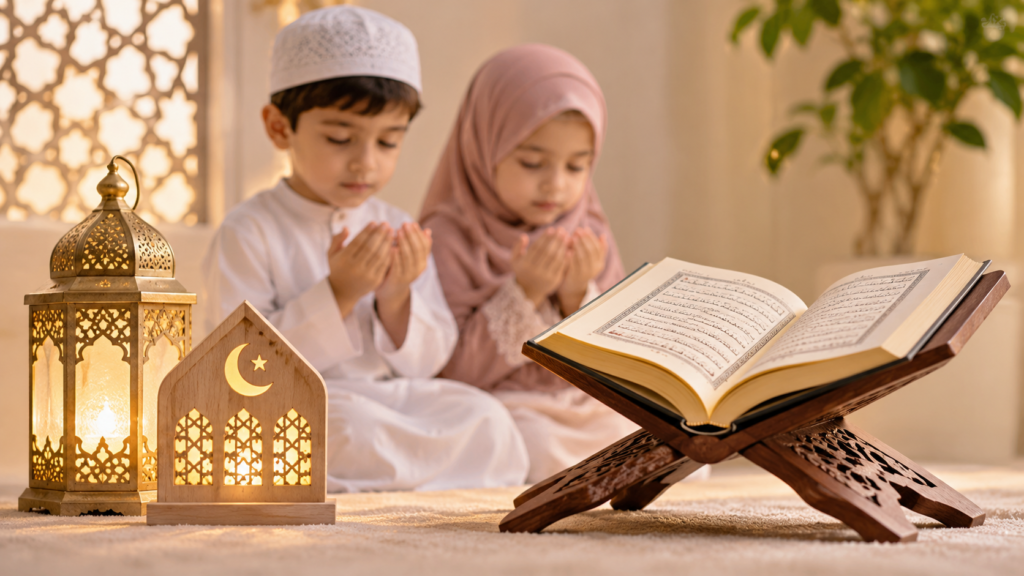
Ruqyah for children is a way for Muslim parents to seek Allah’s protection for their children through Quranic verses and authentic duas while nurturing their faith.
In Islam, Ruqyah Shar’iyyah is a way of seeking Allah’s protection and healing through Quranic verses and authentic supplications (duas).
In this guide, we will explore how parents can perform Ruqyah for their children, which Quranic verses and duas to recite, and how to build a daily routine of remembrance and protection for the whole family.
Let’s discover how to protect our children through the guidance of the Quran and Sunnah.
What Is Ruqyah for Children in Islam?
Ruqyah Shar’iyyah is an Islamic practice of seeking protection and healing through the words of Allah and authentic supplications taught by Prophet Muhammad (peace be upon him).
It involves reciting verses from the Holy Quran and making sincere dua while placing complete trust in Allah.
Ruqyah is not based on superstition or magical practices. It is an act of worship that reminds Muslims that true protection and healing come from Allah alone.
Parents can use Ruqyah for children as part of their regular Quran and dua routine.
Why Is Ruqyah Important for Children?
Children are among the most precious blessings Allah has given us. As Muslim parents, we want to protect them physically, emotionally, and spiritually.
Ruqyah Shar’iyyah helps parents teach their children to turn to Allah for protection, seek His help, and develop a strong connection with the Quran.
Making Quran recitation and daily supplications part of family life can help children grow with faith, trust in Allah, and love for Islamic teachings.
Parents should also remember that Ruqyah does not replace medical care when a child is ill. Seeking appropriate medical treatment is fully compatible with trusting Allah.
Which Quranic Verses Can Parents Recite for Their Children?
The Holy Quran contains verses that Muslims recite when seeking Allah’s protection and healing. Parents can include the following chapters and verses in their daily Ruqyah:
1. Surah Al-Fatihah
Surah Al-Fatihah is known for its healing significance. It was recited as Ruqyah by a companion of the Prophet Muhammad (peace be upon him), and the Prophet approved of this practice.
2. Ayat Al-Kursi (Surah Al-Baqarah, 2:255)
Ayat Al-Kursi is one of the greatest verses in the Quran. Muslims are encouraged to recite it for protection, especially before sleeping.
3. The Last Two Verses of Surah Al-Baqarah (2:285–286)
These two verses have great virtues. The Prophet Muhammad (peace be upon him) taught that whoever recites them at night, they will suffice him.
4. Surah Al-Ikhlas, Al-Falaq, and An-Nas
These three short chapters are especially important in daily remembrance and seeking Allah’s protection. The Prophet Muhammad (peace be upon him) used to recite them before sleeping, blow lightly into his hands, and wipe over his body.
Parents can teach their children these short Surahs from an early age and make their recitation part of the family’s daily routine.
How to Perform Ruqyah for Your Child Step by Step
Parents can perform Ruqyah for their children by following simple steps based on the Quran and authentic Sunnah.
Step 1: Make a sincere intention
Begin with the intention of seeking Allah’s protection and healing, while placing your trust in Him alone.
Step 2: Recite Quranic verses
Recite Surah Al-Fatihah, Ayat Al-Kursi, Surah Al-Ikhlas, Surah Al-Falaq, and Surah An-Nas.
Step 3: Make sincere Dua
Ask Allah to protect your child, grant them good health, and keep them safe from harm.
Step 4: Gently blow into your hands
After reciting Surah Al-Ikhlas, Al-Falaq, and An-Nas, gently blow into your cupped hands and wipe them over your child’s body, as the Prophet Muhammad (peace be upon him) used to do.
Step 5: Make Ruqyah part of your daily routine
Encourage your children to learn these Surahs and daily supplications. Make Quran recitation a natural and comforting part of family life.
Remember that protection and healing come from Allah. Ruqyah should always be performed using Quranic verses and authentic supplications, without superstitious practices or seeking help from anyone besides Allah.
Authentic Dua for Protecting Children
The Prophet Muhammad (peace be upon him) used to seek Allah’s protection for his grandsons, Al-Hasan and Al-Husayn, by reciting this beautiful supplication:
Arabic Dua:
أُعِيذُكُمَا بِكَلِمَاتِ اللَّهِ التَّامَّةِ، مِنْ كُلِّ شَيْطَانٍ وَهَامَّةٍ، وَمِنْ كُلِّ عَيْنٍ لَامَّةٍ.
Transliteration:
U’idhukuma bi kalimatillahi at-tammati, min kulli shaytanin wa hammatin, wa min kulli ’aynin lammah.
Meaning in English:
I seek protection for you both in the Perfect Words of Allah from every devil, every harmful creature, and every evil eye.
How Parents Can Use This Dua:
Parents can recite this supplication when seeking Allah’s protection for their children and make sincere dua for their well-being.
This beautiful supplication reminds us that we should always turn to Allah and seek His protection for our families.
Reference: Sahih al-Bukhari, Hadith 3371 (Narrated by Ibn Abbas).
https://sunnah.com/bukhari:3371
Daily Islamic Protection Routine for Children
Ruqyah for children can be part of a family’s daily routine of Quran recitation and authentic duas.
Building a daily routine of Quran recitation and remembrance helps children develop a strong connection with Allah from an early age.
Here are some simple habits Muslim parents can encourage:
1. Morning and Evening Adhkar
Teach your children to recite authentic morning and evening supplications and the three Quls: Surah Al-Ikhlas, Al-Falaq, and An-Nas.
2. Reciting Ayat Al-Kursi Before Sleeping
Encourage your children to recite Ayat Al-Kursi before going to bed.
3. Reciting the Last Two Verses of Surah Al-Baqarah
Make it a habit to recite the last two verses of Surah Al-Baqarah at night.
4. Teaching Children to Make Dua
Encourage children to ask Allah for protection, guidance, good health, and blessings.
5. Making Quran Part of Family Life
Set aside a few minutes every day for Quran recitation and learning Islamic teachings together.
Consistency is more important than making the routine complicated. Help children develop these habits with love, patience, and encouragement.
Frequently Asked Questions (FAQ)
Frequently Asked Questions About Ruqyah for Children
1. Can parents perform Ruqyah on their children?
Yes. Parents can perform Ruqyah for their children by reciting Quranic verses and authentic supplications while seeking protection and healing from Allah.
2. What Surahs should I recite for my child?
Parents can recite Surah Al-Fatihah, Ayat Al-Kursi, Surah Al-Ikhlas, Surah Al-Falaq, and Surah An-Nas.
3. Can I perform Ruqyah for my child every day?
Yes. Parents can regularly recite Quranic verses and authentic supplications for their children as part of their daily worship and remembrance of Allah.
4. Can Ruqyah protect children from the evil eye?
Muslims may seek Allah’s protection from the evil eye through authentic Quranic recitation and supplications. However, we should not assume that every illness or difficulty is caused by the evil eye.
5. Does Ruqyah replace medical treatment?
No. Ruqyah does not replace medical care. Parents should seek appropriate medical advice and treatment whenever their child is unwell.
Parents can use Ruqyah for children as part of their regular Quran and dua routine.
At Tilawah Institute, we help children build a strong connection with the Quran through personalized online Quran classes.